
PRRS Resident Overview
Pre-Release and Reentry Services is operated by the Montgomery County DOCR Community Corrections Division. It is not a conventional booking jail. PRRS serves carefully screened adults with one year or less remaining on a sentence, people with county sentences, and some people returning to Montgomery County from state or federal prison within six months of release. The program links custody control with employment, treatment, housing, family support, and case management.
The county describes the Pre-Release Center as a state-accredited community corrections facility with American Correctional Association accreditation. The local setting matters. PRRS is in the White Flint and Rockville area, which the county identifies as useful for work release because participants need access to jobs and public transportation. A PRRS resident may be working in the community, attending treatment, returning to the center, or moved back to secure detention if rules are violated.
The official PRRS page shows the 144-bed Pre-Release Center and describes the work-release model.
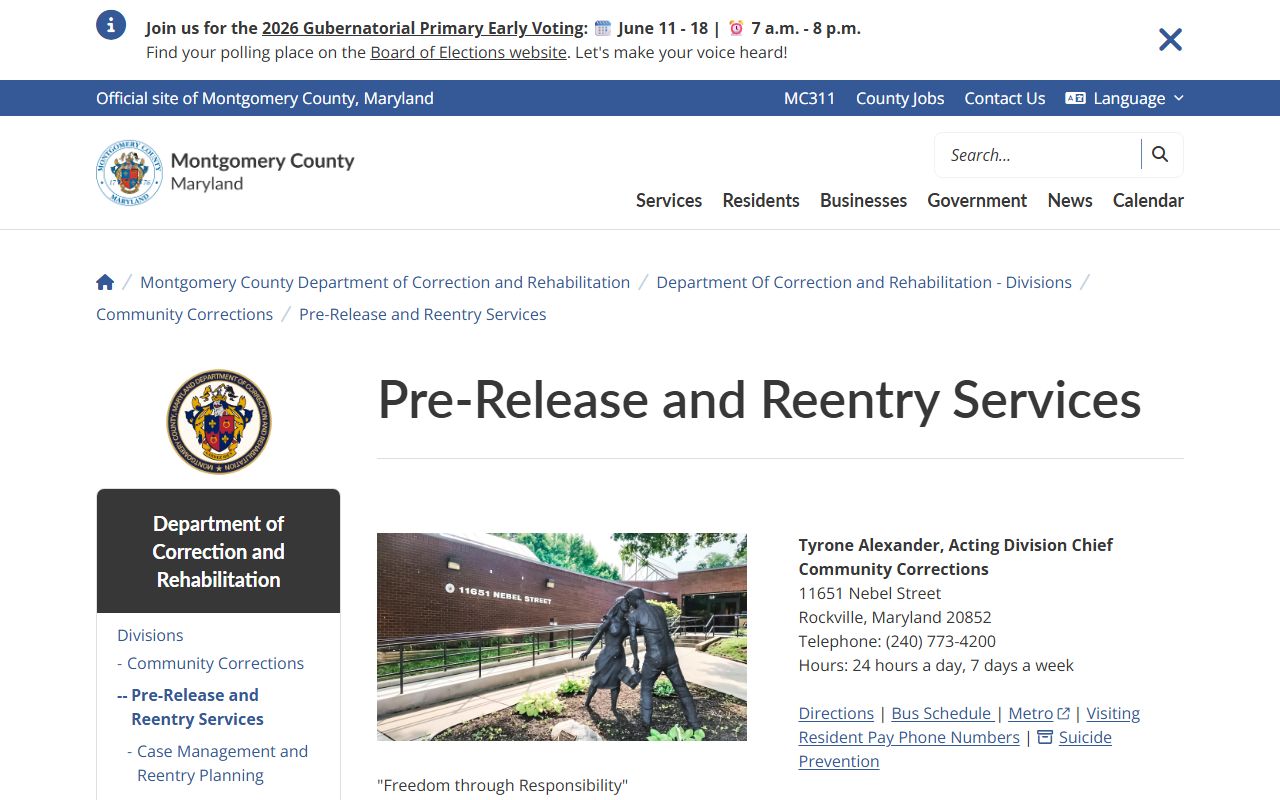
The screenshot fits the PRRS page because it documents the county's own description of the center, its capacity, and its reentry focus.
PRRS Resident Capacity
Montgomery County publishes a PRRS capacity of 144 beds. The county also reports that PRRS began in 1972 and has served more than 20,000 people. The research file includes detailed 2019 outcome measures: 353 individuals served, 80 percent successful completion, 80 percent released with private-sector employment, more than $1.4 million earned, nearly $300,000 in taxes, $130,000 in family support, $266,652 in program fees, $4,293 in restitution, and 53,400 jail bed-days diverted.
Those PRRS numbers should be read as community corrections outcomes, not jail booking totals. A PRRS participant may still be under correctional control, but the daily routine can include work, treatment, monitored community access, home confinement, testing, and required payments. That is why PRRS lookup copy should use resident and participant language where it fits, while still explaining the custody path.
PRRS also affects the larger Montgomery County inmate population by diverting jail bed-days. The 2019 bed-day figure shows how a structured work-release center can reduce secure detention pressure while keeping participants under rules. It is not a promise that any given person will qualify. Screening, sentence length, county ties, program behavior, and public-safety review all matter.
PRRS Resident Lookup
Montgomery County does not publish a public PRRS roster. The county Inmate / Resident Records page says DOCR has no automated offender list, and that statement applies across MCDC, MCCF, and PRRS. For a person believed to be in PRRS, call PRRS at 240-773-4200 or call Inmate Records at 240-777-9730 when the question is current custody location or a county ID number. If the person came from state prison, the Maryland DPSCS locator may help explain prior or current state custody.
- Confirm whether the person is a PRRS resident, an MCCF inmate, or still in MCDC intake.
- Call PRRS for program-specific status, visiting, and resident routing questions.
- Call Inmate Records for county custody location and resident or inmate ID questions.
- Use Maryland VINELink for custody notifications if the person appears in that system.
- Search Maryland Judiciary Case Search for court cases, warrants, violations, and court dates tied to the sentence.
Do not treat PRRS like a public recent-booking list. The program serves a screened group, and participants can move between work release, home confinement, secure detention, state custody, or release depending on sentence status and rule compliance.
| Status Question | Where to Start | Useful Detail to Have |
|---|---|---|
| Is the person in PRRS? | PRRS or Inmate Records | Full name, date of birth, county ID if known. |
| Was the person moved from MCCF? | Inmate Records | Last known facility and approximate transfer date. |
| Did state custody end? | DPSCS locator and PRRS | State name record and expected release window. |
| Is there a court violation? | Maryland Judiciary Case Search | Case number, charge, or hearing date. |
PRRS Address and Contact
PRRS contact questions are best split by purpose. Call PRRS for program, visiting, resident, and community-corrections questions. Call Inmate Records when the need is to confirm county custody location or obtain a county inmate or resident ID. The research file identifies Tyrone Alexander as Acting Division Chief for PRRS and lists the facility as open 24 hours a day, 7 days a week.
Montgomery County Pre-Release Center / PRRS
11651 Nebel Street
Rockville, MD 20852
(240) 773-4200
Open 24 hours a day, 7 days a week
County Inmate Records
ATTN: Inmate Records
1307 Seven Locks Road, Rockville, MD 20854
(240) 777-9730
Call for custody location and ID questions
PRRS Visiting Rules
Research located a separate resident visiting reference for PRRS but did not harvest a full PRRS schedule in accessible text. That means the accurate public instruction is to confirm directly with PRRS before traveling. County visitation rules for secure jail visits still offer useful baseline rules: valid photo ID, parent or guardian accompaniment for minors, dress-code compliance, security clearance, and cancellation for operational needs. PRRS may also have program-specific limits tied to work schedules, community access, sanctions, or home confinement status.
| Facility | Published Hours | Notes |
|---|---|---|
| PRRS | Separate resident visiting page referenced; schedule not extracted in research | Call PRRS at (240) 773-4200 before traveling or planning a visit. |
| MCCF / MCDC contrast | MCCF and MCDC have separate jail schedules | Do not use MCCF or MCDC visiting hours for PRRS unless PRRS confirms them. |
Video visitation through ICSolutions / The Visitor is documented for Montgomery County jail visitation. Use it for PRRS only if PRRS staff confirms the resident is eligible and the platform applies to that visit type.
PRRS Mail and Money
PRRS residents are still under DOCR control, but the money and daily-routine context is different from MCCF or MCDC. Participants must work when approved, pay room and board, file state and federal taxes, address restitution or child support, and follow approved community access rules. The general county inmate information source says commissary orders can be placed through Maryland Package, while PRRS program fees and room-and-board obligations are part of the work-release model. Confirm the correct payment route before sending funds.
| Service | Provider / Detail |
|---|---|
| Mail Address | Use PRRS address with resident name and county-confirmed ID; verify resident mail rules first. |
| Phone / Video | Call PRRS for resident contact rules; ICSolutions is documented for county video visitation where eligible. |
| Commissary | Maryland Package is county-linked for commissary orders; family order limit is $25 per week for jail commissary. |
| Program Payments | PRRS participants may owe room and board, family support, restitution, taxes, or program fees. |
| Accounting | For county funds questions, Inmate Accounting is listed at (240) 773-9731. |
Because PRRS is a reentry program, payment questions may involve more than a standard jail commissary order. Ask staff which account, fee, or support payment applies.
PRRS Admission Process
PRRS admission is not street-arrest booking. Participants are carefully screened and may include adults with one year or less remaining on a sentence, county-sentenced people, and county residents returning from state or federal prison. The program uses risk and needs assessment, case management, a work-first philosophy, cognitive behavioral programming, monitored community treatment, substance-abuse testing, and home confinement with electronic or GPS monitoring.
Violations can lead to immediate return to secure detention. The research describes zero tolerance for criminal activity, drugs or alcohol, and unauthorized community access. That is why a resident's location can change from PRRS to MCCF or another custody setting. For court violations or new charges, Maryland Judiciary Case Search may show the case event, but county records or PRRS staff are still needed for current placement.
Home confinement is part of the PRRS continuum, but it is not the same thing as release without supervision. A person may live or work in the community while still being monitored by DOCR. Electronic or GPS monitoring, substance testing, case-manager contact, and work-release rules can all shape the resident's status. If the person stops following those rules, the custody path can move back toward secure detention.
PRRS Reentry Programs
PRRS is the most distinctive Montgomery County facility in the research file. The county reports that the program has operated since 1972 and served more than 20,000 people. Its "Freedom through Responsibility" model connects work, treatment, housing, family support, and accountability. Local program names include work release, home confinement, family and friends support, Alternative Community Service, Jail Addiction Services, the Intervention Program for Substance Abusers, and Reentry Employment Development Endeavor.
The 2019 outcomes show why PRRS belongs on a Montgomery County inmate population site even though it is not a traditional jail roster page. The county reported 80 percent successful completion and 80 percent private-sector employment at release for that year. It also reported taxes, family support, program fees, restitution, and jail bed-days diverted. Those details explain how PRRS reduces secure jail pressure while still operating under DOCR supervision.
Note: Confirm PRRS status directly before visiting, because work release and sanctions can change a resident's location.